Search our website for news, courses, and general information
13th May 2026
On 11th June , our Level 4 Creative Enterprise students delivered their final business pitches to an industry panel, marking the culmination of a year-long journey exploring creativity, enterprise, and professional practice. The session demonstrated the ambition and maturity that students have developed during this course.
The panel - Amy Braganca (Marketing Manager), Alan Muza (Head of Finance), and Nicola Fowler (Creative Industries Lecturer and Photography Business Owner) - challenged and encouraged the students to think critically about how their creative ideas translate into sustainable, real‑world businesses.
“What came through very clearly was that these students put a lot of thought into their business idea,” said Amy Braganca. “Whether it’s personalisation, storytelling, or values‑led photography, they’re already thinking about audiences, emotional connection, and how to position themselves in competitive markets.”
Across all four presentations, students demonstrated extensive research, supported by competitor analysis, pricing strategies, marketing plans, and clearly articulated creative vision. Their work reflected not only personal passion, but also a strong understanding of audience behaviour, monetisation, and professional standards.
“Creative passion is important,” noted Alan Muza, “but it’s the financial realism behind these ideas that makes them viable businesses rather than just concepts. The confidence students showed when discussing pricing, costs, and sustainability was particularly encouraging.”
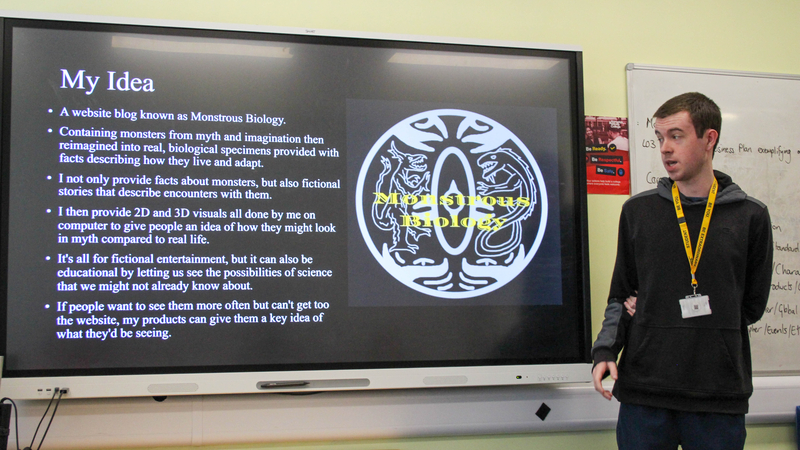
Sean – Speculative illustration and character development
Sean’s presentation explored a highly imaginative, yet carefully structured illustration business centred on reimagining mythical monsters as biologically plausible creatures. Drawing inspiration from childhood television (The Troop), speculative evolution artists such as Joshua Dunlop and Dougal Dixon, and documentaries like Beast Legends, Sean has developed a WordPress-based platform that combines fiction, biology, and mythology.
What stood out was Sean’s thoughtful consideration of how a niche creative passion could evolve into a viable business. His monetisation plans included illustrated prints, sketchbooks, merchandise, 3D models, and educational products, with longer-term ambitions of publishing and collaboration.
Sean is a mature student originally from Texas and now living in the UK. While public speaking can be challenging, his research, planning, and clarity of intent were evident throughout the presentation, demonstrating a strong grasp of both creative development and enterprise thinking.
“The level of commitment and depth of research in Sean’s work is impressive,” said Nicola Fowler. “There’s a clear sense that his creative thinking could translate very well into publishing and educational contexts.”
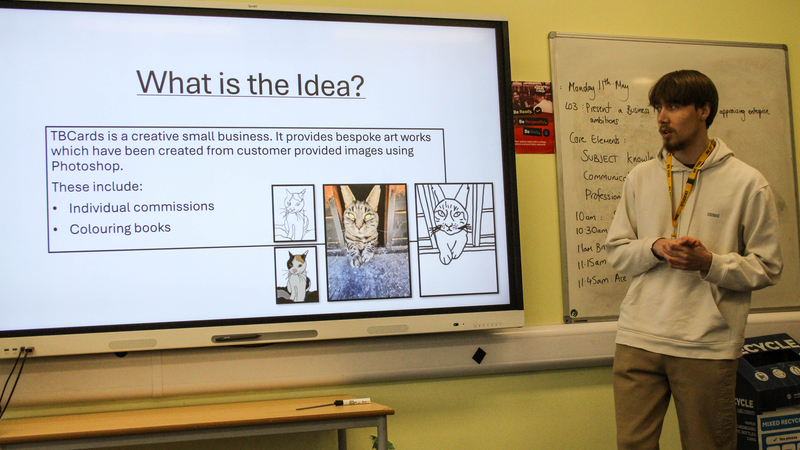
Tom – Personalised illustration, cards, and colouring books
Tom presented his business idea focused on hand‑drawn illustrations created from customer‑submitted images, primarily pets. These illustrations form the basis of personalised colouring books, greeting cards, and prints, with a strong emphasis on mindfulness, emotional connection, and memory‑making.
When Tom joined the course, he was unsure about his next steps and was clear that university was not a route he wanted to follow. Instead, he expressed a desire to work for himself; but initially proposed a highly complex idea that would have required years of development, technical infrastructure, and significant financial investment. Through the year, his thinking has evolved considerably. With guidance, testing, and reflection, Tom refined his concept into a much more focused, realistic, and market‑ready business, without losing its creative value.
His proposal responds directly to an identifiable market need, balancing personalisation with scalability, manageable production, and realistic pricing. The result is a clear and achievable business concept that positions Tom to move straight into self‑employment on completion of the course, with strong foundations for future growth.
“From a marketing perspective, Tom’s idea is deceptively strong,” noted Amy Braganca. “Personalisation creates emotional value, and emotional value drives purchasing decisions -especially in markets like pets, gifts, and wellbeing.”
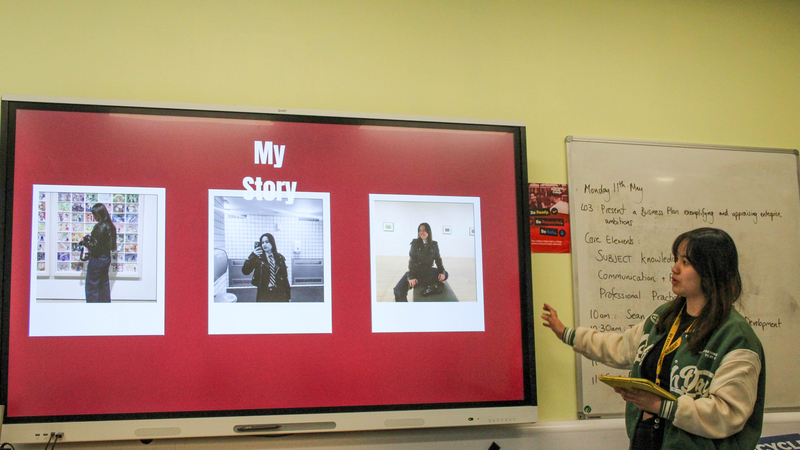
Nellaine – Photography, Travel, and Visual Storytelling
Nellaine presented a photography business rooted in storytelling and high technical quality, combining commercial photography with global travel influences. Her work demonstrated excellent control of lighting, framing, colour, and resolution.
Her background in baking and event management has clearly informed her understanding of branding and promotional imagery. The panel highlighted that her café and business photography was already of professional standard, encouraging her to position herself confidently as a freelance photographer. Alongside commercial commissions, Nellaine plans to retain an artistic element through framed prints, posters, notebooks, and postcards, as well as launching bespoke photo filters for platforms such as CapCut and delivering photography workshops.
Having joined the course late and studying alongside part‑time work, Nellaine has faced significant challenges - particularly with English as a second language. Originally from the Philippines and having relocated to the UK specifically for the course, her visual outcomes nonetheless demonstrated a strong grasp of professional practice and creative intent.
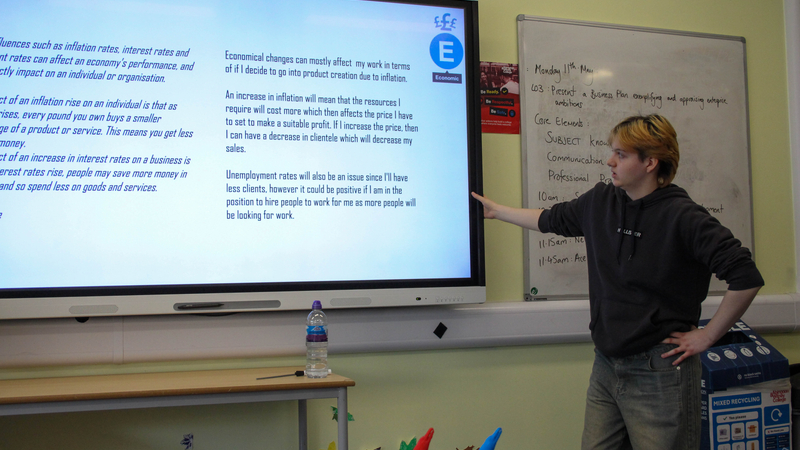
Ace – Photography as Activism, Identity, and Events
Ace’s presentation offered a powerful example of how photography can function as both creative expression and social commentary. Their practice is centred on emotion, nostalgia, activism, and identity, with core themes including environmental awareness, LGBTQ+ visibility, mental health, and anti‑AI ethics.
Ace proposed a dual model:
Influenced by films such as Jennifer’s Body and Barbie, games like The Last of Us, music, colour theory, and concept photography, Ace demonstrated impressive research depth and a clearly defined artistic voice. The panel encouraged a focus on journalistic and documentary photography, while also reinforcing the importance of financial sustainability. Ace also expressed a strong interest in positioning themselves as a queer wedding photographer, supporting community visibility through professional practice.
Balancing the course alongside part‑time work, Ace is considering a Photography degree at Oxford Brookes as a potential next step.
Across all four pitches, the panel consistently reinforced the importance of:
“These students are thinking like practitioners, not just creators,” reflected Nicola Fowler. “They’re developing strong creative identities while also understanding how the creative industries actually function.”
The session concluded with recognition of the students’ dedication - particularly those studying alongside full‑time work - and their clear potential as emerging professionals. Students demonstrated impressive creativity, professionalism, and entrepreneurial potential. With further development, guidance, and real-world application, each has the capability to turn their ideas into successful creative enterprises.
All four students will be showcasing their work at the End of Year Exhibition at the Abingdon Campus, offering the public an opportunity to experience first-hand the ambitious projects that define their Creative Enterprise journey.
Exhibition Open Monday 1st June - Friday 12th June
10:00 am - 4:00pm daily